
Report 20 pages
The State of Lead Generation 2026
What actually turns content into pipeline now that buyers do 80% of the journey before they ever talk to you.
Read →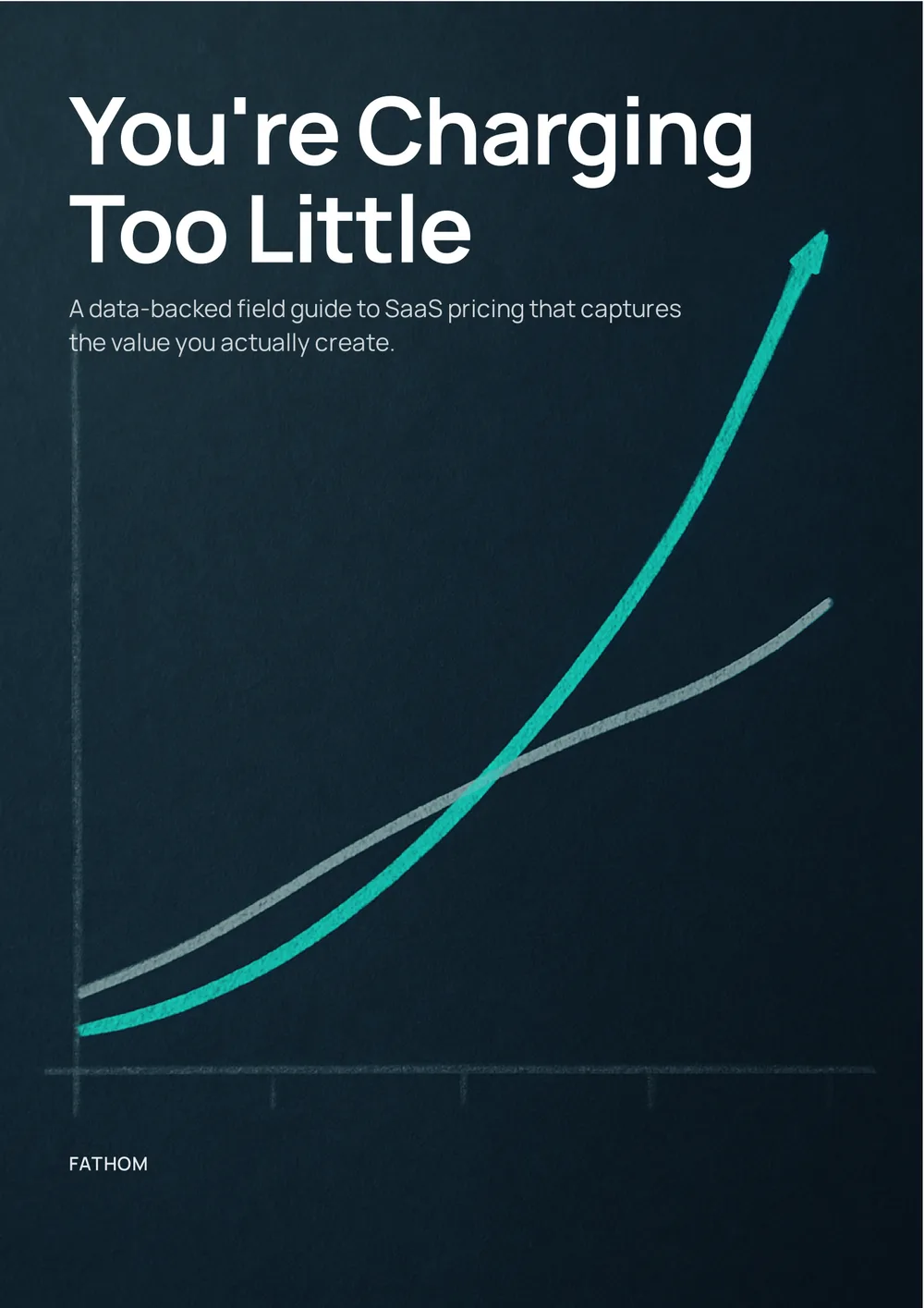
Why most software is underpriced, how to find the number you should be charging, and how to raise prices without losing customers.
Reads in your browser, no download, no email. Made with Unplain.
The Underpricing Epidemic
Why 92% of software companies price without research, and why price is the highest-leverage number in the business.
The Three Ways to Set a Price
Cost-plus, competitor-based, and value-based: two of which feel like safety and are traps.
Find Your Value Metric
The unit you charge per, the three properties a good one has, and why per-seat is quietly wrong for many products.
What Are They Actually Willing to Pay?
The Van Westendorp price sensitivity meter, and why willingness to pay is never one number.
Designing Tiers That Sell
Why good-better-best works, what the top tier is really for, and the rules that keep tiers from backfiring.
Raising Prices Without Losing Customers
Why the math is almost always on your side, plus a five-step playbook including grandfathering and off-ramps.
The Pricing Audit
Ten questions across foundation, value metric, willingness to pay, packaging and discipline, with a scoring guide.
Most software is underpriced, and the companies that make it rarely find out. Underpricing doesn’t announce itself: there’s no error message, no angry customer, no line on the P&L labelled “money we could have had.” The product sells, revenue grows, and the gap between price and value quietly compounds.
This field guide from Fathom opens with a survey of 1,200 software companies in early 2026, and one number that frames everything after it: 92% set their prices without any structured research into willingness to pay. They copied a competitor, added a margin to their costs, or picked something that felt right.
A 1% improvement in price drives more profit than a 1% improvement in volume, cost, or acquisition. The reason is mechanical: a price increase falls almost entirely to the bottom line, because you have already paid to build and sell the product. There is no additional cost to serve a customer who pays 10% more.
And yet pricing gets a fraction of the attention acquisition does. Companies spend six months optimising a signup funnel to lift conversion two points, while the price at the end of that funnel (the number that determines the value of every single conversion) was set in an afternoon three years ago.
It also leaks into everything else. Price too low and you attract bargain-hunters who churn hard and file the most support tickets; the cheapest customers are almost always the most expensive to serve. Customers paying a price aligned with the value they get stay longer, because the relationship makes sense to them.
Cost-plus is the accountant’s trap. Your costs have nothing to do with your customer’s value. A tool that costs €2 per user per month to run might save a customer €4,000 a month; cost-plus would have you charge €5 and feel clever about the margin. Software’s marginal costs are near zero, which anchors you to the one number that matters least.
Competitor-based is the sheep’s trap. Remember that 92%: when you copy a competitor you are not inheriting insight, you are inheriting their guess and compounding it across the category. Competitor pricing is a useful input for knowing where the market’s mental anchors sit. It is a catastrophic foundation.
Value-based is harder, and it is the only method that can be right rather than merely defensible.
The value metric is the unit your pricing scales on: per seat, per contact, per gigabyte, per invoice sent. A good one aligns with the value the customer gets, is easy enough to understand that they can predict their bill, and grows as the account grows, which is the engine behind net revenue retention above 100%.
Per-seat is the B2B default and quietly wrong for many products, because it charges for access rather than value. A billing tool’s value scales with invoices processed, not with the two finance people who log in. Price per seat on a product whose value scales differently and two bad things happen: customers ration seats to control cost, limiting how far your product spreads inside the account, and your revenue decouples from the value you deliver.
The question to ask is simple: when does this customer succeed, and what number goes up when they do?
The step almost everyone skips. The Van Westendorp Price Sensitivity Meter (four questions, a survey technique from 1976) takes a few hundred responses and an afternoon of analysis to produce a defensible price range. Most companies have never run it once.
The insight underneath it is that willingness to pay is never one number. A solo freelancer and a 500-person enterprise don’t get the same value, don’t have the same budget, and shouldn’t pay the same price. Charge them identically and you scare off the freelancer while massively undercharging the enterprise, usually both at once. The answer isn’t one perfect price; it’s segmentation, using features and usage tiers as fences that let each segment self-select.
The report closes with a ten-question pricing audit and a scoring guide, which is the fastest way to find out whether you’re in the 92%.
This is a real report from a pricing consultancy, published as an ungated PDF, and it is in this library because it shows what a finished Unplain document looks like when the content is dense: comparison tables, a do/don’t grid, chapter openers, and a scored audit, none of which were laid out by hand. The manuscript was written as a plain document and Unplain produced the rest.
Published July 23, 2026
What actually turns content into pipeline now that buyers do 80% of the journey before they ever talk to you.
Read →
Why your coffee tastes sour or bitter, what actually fixes it, and the expensive gear that changes nothing.
Read →
A short, honest introduction to existentialism, and why a philosophy of anxiety turns out to be the hopeful one.
Read →The manuscript was written as plain text. Unplain added the cover, the table of contents, the page numbering, the brand colours and the closing call-to-action page, and returned a publish-ready PDF: no editor, no page-by-page layout. Your document works the same way.
No signup needed. Short ebooks are on us, forever.