Report 19 pages
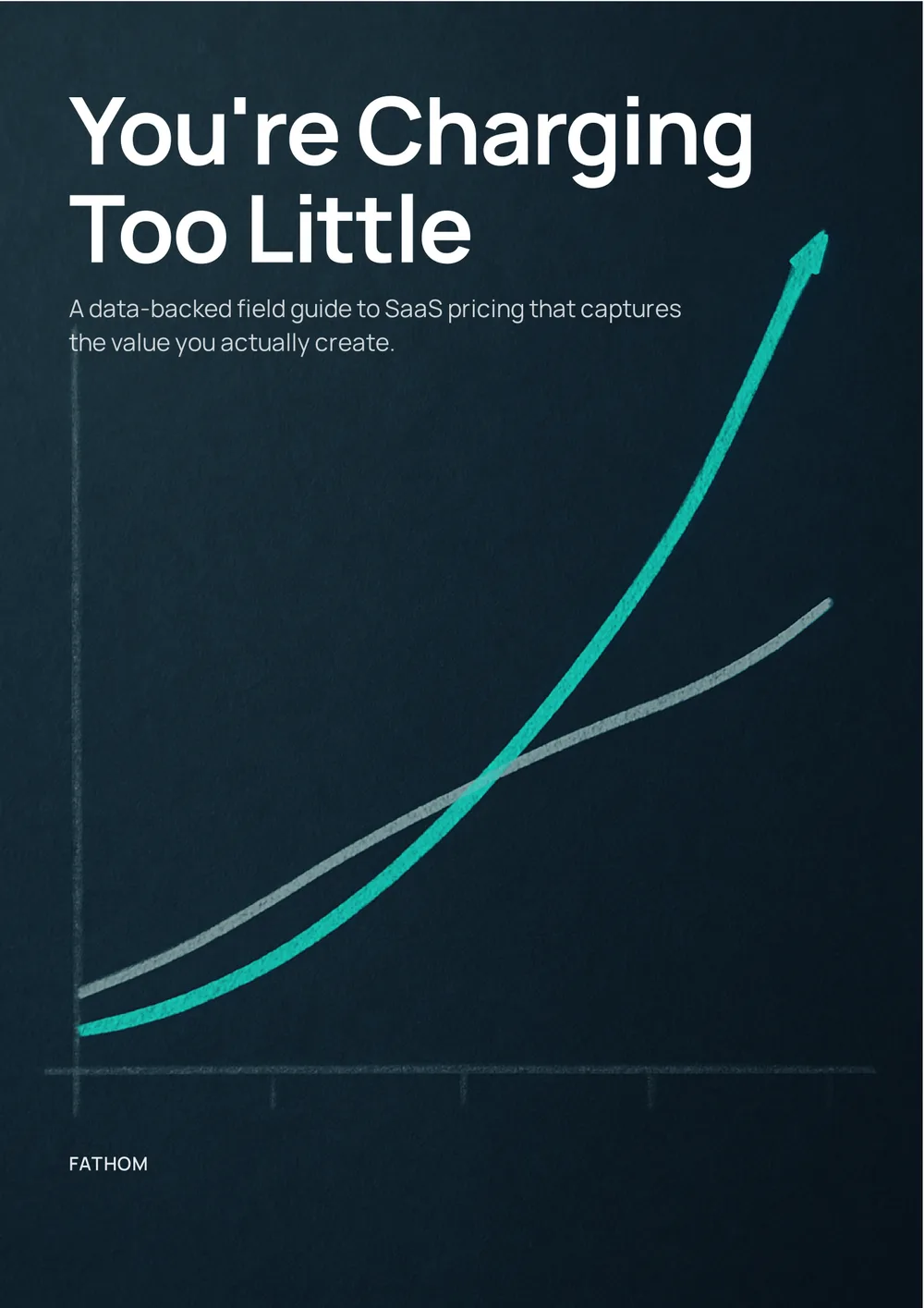
You're Charging Too Little
Why most software is underpriced, how to find the number you should be charging, and how to raise prices without losing customers.
Read →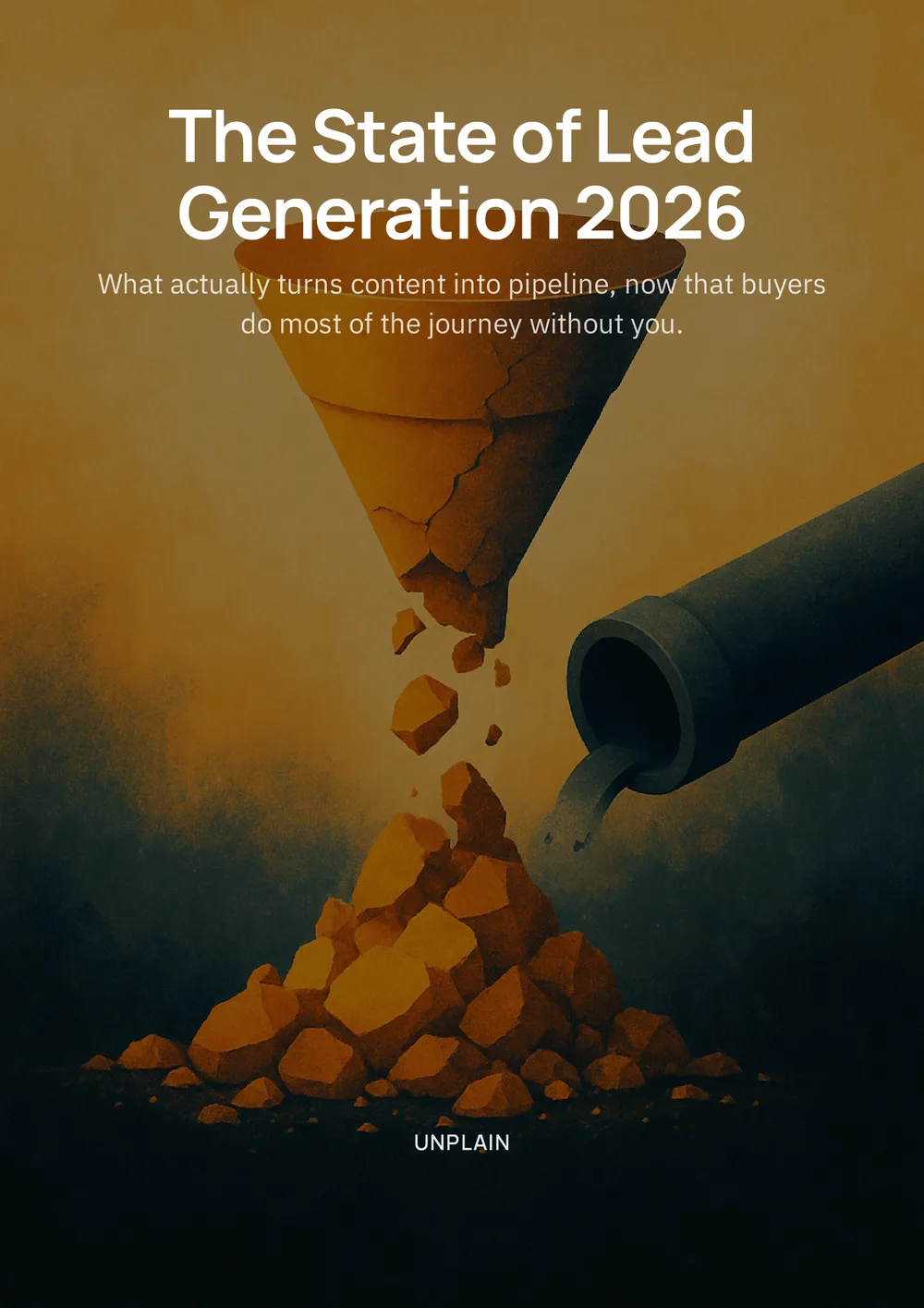
What actually turns content into pipeline now that buyers do 80% of the journey before they ever talk to you.
Reads in your browser, no download, no email. Made with Unplain.
The Buyer Changed. Your Funnel Didn't.
Buyers finish 70–80% of the journey before contacting a supplier, so your content now does the selling the rep used to do.
What's Dead, and What Works
The honest split: generic ebooks, gate-everything and download-counting are losing ground; specific expertise, original data and measured reads are pulling ahead.
Build the Asset for the Reader, Not the Download
Pick a promise not a topic, put your best value on page one, and treat the finished artifact as the argument for your competence.
Track Reads, Not Downloads
Deliver a tracked link, instrument open rate, read completion, per-page drop-off and CTA clicks: the data that actually predicts pipeline.
Earn the Next Step
Match the offer to the moment, make a small specific ask, and place several CTAs by intent instead of one demo plea at the end.
Win the Minutes After
Speed-to-lead for genuine intent, a give-before-you-ask nurture for everyone else, and routing sales on behavior rather than the download.
Do This On Monday
The report in one page: seven concrete changes, from auditing your top asset for reads to rebuilding nurture to give four times before it asks once.
Somewhere in the last few years, buying stopped being something a salesperson guided you through. Forrester now puts B2B buyers at roughly 70 to 80 percent of their journey completed before they ever contact a supplier, and Gartner’s figures fill in what they do with that time: only about 17 percent of the purchase journey is spent with suppliers at all, and as little as 5 to 6 percent with any single sales rep. The buyer does most of the work alone, in private, and shows up late. By the time they reach your form, the evaluation is mostly over.
That single fact rewrites everything downstream, which is what this field report from Throughline is about. If most of the decision happens before contact, your content is not “top-of-funnel awareness fluff” that warms people up for the real selling. Your content is the selling. It has to do the job the rep used to do: answer the hard questions, prove the expertise, and earn enough trust that the buyer puts you on the shortlist they assemble without you in the room.
The broad “Ultimate Guide to X” was always the weakest asset in the library, and generative AI has ended it. Basic informational content is now trivially easy to generate and to find, so a generic guide competes directly with a free, instant AI answer, and loses. Gartner’s 2026 research found that 45 percent of buyers used generative AI during a recent purchase and weighed an average of seven information sources before deciding. Nobody trades an email address for the surface explanation anymore, because they can get it in one prompt.
What still works is the opposite of generic. A narrow asset that solves one real problem for one real buyer performs precisely because it carries judgment an AI summary cannot replicate. Analyst reports, peer reviews and detailed comparisons rank at the top of buyer-cited influence; generic early-stage blog content ranks near the bottom. Original data (benchmarks, real numbers, calculators) gets cited, linked and shared, and positions you as a source rather than a vendor.
The instinct to lock every asset behind a form made sense when your PDF was the only way to get the information. Now gating everything suppresses the reach that AI search and answer engines reward, and a buyer with seven other sources simply goes elsewhere rather than fill out your form. The mistake is treating “gated versus ungated” as an identity choice. It is not. Gate the assets whose value is invisible from the outside (original data, templates, working tools) and open the ones that build reach and trust. Decide per asset by comparing pipeline, not list size.
The download is a permission slip, not a read, and it survives as a metric only because it is easy and flattering. Read rate is the single most predictive number in gated content, because everything downstream depends on it, and almost no team collects it. Deliver the asset as a unique, tracked link rather than an email attachment, and you can instrument the four things that matter: whether it was opened at all, how far people actually got, the exact page where they quit, and whether the read turned into a click. Per-page drop-off is the most actionable content data you will ever get: if everyone abandons on page three, page three is the problem, and now you know.
A read that leads nowhere is a nice gesture, not pipeline. Most assets get the call to action wrong in the same two ways: one generic “book a demo” plea at the very end, aimed at a reader who is nowhere near ready to talk to sales. Match the offer to the moment instead (the editable template behind the framework they just read, a short assessment, the next asset in the sequence) and save the demo ask for buyers whose behavior shows they are close. Then move fast when intent is real: contacting a high-intent lead within five minutes makes you far more likely to qualify it than waiting thirty, yet the average B2B response time is measured in dozens of hours. Route sales on the compound signals: repeated engagement, a pricing-page visit, a reply, not on a single download.
This is a real field report, published as an ungated PDF, and it is in this library because it practises what it argues: the value is on page one, the research is cited at the point of use, and the document is built to be finished rather than skimmed. The manuscript was written as a plain document; the cover, the contents page, the callout boxes and the closing CTA page were produced by Unplain.
Published July 28, 2026
Why most software is underpriced, how to find the number you should be charging, and how to raise prices without losing customers.
Read →
Why your coffee tastes sour or bitter, what actually fixes it, and the expensive gear that changes nothing.
Read →
A short, honest introduction to existentialism, and why a philosophy of anxiety turns out to be the hopeful one.
Read →The manuscript was written as plain text. Unplain added the cover, the table of contents, the page numbering, the brand colours and the closing call-to-action page, and returned a publish-ready PDF: no editor, no page-by-page layout. Your document works the same way.
No signup needed. Short ebooks are on us, forever.